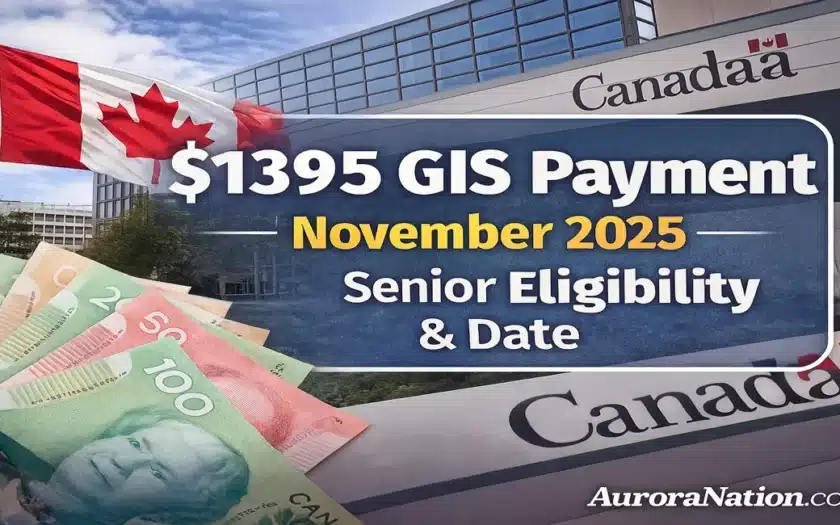
As living costs continue to rise across Canada, seniors relying on fixed incomes—especially those receiving the Guaranteed Income Supplement (GIS)—are feeling the most pressure. With rising grocery prices, transportation costs, medications, rent increases, and higher winter energy bills, many older Canadians are eagerly following discussions surrounding a proposed $1395 GIS Payment expected by some policy analysts to arrive on November 26, 2025.
While this payment has not yet been officially confirmed by the federal government, it is one of the most discussed potential affordability supports for seniors heading into the 2025–26 winter season.
This article provides a complete, factual, and senior-focused explanation of what the $1395 GIS Payment could mean, how it may work, who would benefit, and what signs to watch for.
Also read: CPP and OAS Cost-of-Living Adjustment 2026: How Much Will Benefits Increase?
What Is the Proposed $1395 GIS Payment for Seniors?
The $1395 GIS Payment is a proposed one-time federal affordability top-up aimed specifically at low-income seniors who qualify for GIS.
The objective of the $1395 GIS Payment would be to:
- Help cover rising living and winter heating costs
- Boost senior purchasing power during high-expense months
- Provide relief for the most financially vulnerable older adults
- Support seniors living on limited CPP, OAS, and GIS income
Because GIS is already income-tested and focused on the lowest-income seniors, a one-time $1395 payment would be both targeted and impactful.
For official GIS eligibility details, seniors can review the Government of Canada page:
Guaranteed Income Supplement (GIS)
https://www.canada.ca/en/services/benefits/publicpensions/cpp/old-age-security/gis.html
Why November 26, 2025 Is Being Discussed
Several factors point to November 26, 2025 as a plausible potential payment date for the $1395 GIS Payment:
1. Winter Costs Surge in Late November
Heating fuel, natural gas, food prices, and travel costs generally rise heading into December.
2. Federal Announcements Often Occur in the Fall Economic Statement
In previous years, affordability measures were introduced in late fall.
3. Historical Precedent
Canada has issued targeted supports during similar periods, such as:
- November 2022 GST top-up
- July 2023 Grocery Rebate
4. Seniors Are the Hardest-Hit Income Group
Advocacy groups have repeatedly urged the federal government to provide targeted financial relief for GIS recipients.
Who Would Qualify for the $1395 GIS Payment?
If introduced, eligibility would almost certainly focus on seniors who already qualify for GIS.
Likely Eligibility Requirements
To receive the $1395 GIS Payment, seniors would likely need to:
- Be 65 or older
- Be currently receiving GIS
- File their 2024 income tax return
- Be a resident of Canada
- Have income below the GIS income thresholds
GIS income thresholds (official reference):
GIS Income Requirements
https://www.canada.ca/en/services/benefits/publicpensions/cpp/old-age-security/payments.html
Who Would Benefit Most?
- Single seniors receiving full GIS
- Seniors living alone on fixed incomes
- Widowed seniors
- Seniors with minimal CPP earnings
- Seniors heavily impacted by winter heating costs
No application is expected—GIS recipients would likely receive the payment automatically.
How Much Would the $1395 GIS Payment Provide?
If approved:
One-Time Amount:
$1395 per eligible senior or household
This would represent one of the largest one-time affordability supports issued to seniors by the federal government in recent years.
Like all GIS-related supports, the $1395 GIS Payment would likely be non-taxable.
How Seniors Would Receive the $1395 GIS Payment
If approved, the payment would likely be sent using the same systems that deliver monthly OAS and GIS payments:
1. Direct Deposit (Recommended)
Deposited directly into the senior’s bank account.
Direct deposit information can be updated here:
Set Up CRA Direct Deposit
https://www.canada.ca/en/revenue-agency/services/about-canada-revenue-agency-cra/direct-deposit.html
2. Cheque by Mail
For seniors not enrolled in direct deposit.
3. Automatic Processing
Because GIS is already income-tested, seniors would not need to apply for the payment.
Why the $1395 GIS Payment May Be Necessary in 2025
Economic factors support the need for targeted senior relief:
High Food Prices
Grocery costs remain significantly above pre-2020 levels.
Heating and Energy Bills Rising
Forecasts show higher natural gas and electricity prices for winter 2025–26.
Seniors Spend More on Essential Goods
Older adults spend more on medication, health supplies, and home heating.
Fixed Incomes Do Not Adjust Fast Enough
Even with OAS and GIS indexing, increases often lag behind real inflation.
GIS Recipients Are Among Canada’s Most Vulnerable Populations
They are the lowest-income seniors in the country.
How Seniors Can Prepare Now
Even before the government confirms the $1395 GIS Payment, seniors can take steps to ensure they don’t miss out:
1. File Your 2024 Income Tax Return
GIS eligibility is reevaluated every year based on taxes.
2. Set Up Direct Deposit
Ensures faster payment delivery and avoids mail delays.
3. Keep Information Updated
This includes marital status, address, banking info.
4. Monitor Official Government Announcements
Government of Canada Newsroom:
https://www.canada.ca/en/news.html
5. Check Your My Service Canada Account (MSCA)
Seniors can view GIS/OAS status here:
MSCA Login
https://www.canada.ca/en/employment-social-development/services/my-account.html
Frequently Asked Questions
Is the $1395 GIS Payment confirmed?
No. It is widely discussed but has not been formally announced.
Will seniors need to apply?
No. If implemented, GIS recipients would receive it automatically.
Is the payment taxable?
No. GIS-related top-ups are normally tax-free.
Will the payment affect OAS or CPP?
No. A one-time relief payment would not reduce or replace any existing benefits.
Final Summary
The proposed $1395 GIS Payment on November 26, 2025 has become one of the most anticipated potential financial supports for low-income Canadian seniors. While still unconfirmed, the timing, economic need, and policy pressure suggest that a targeted one-time relief payment is possible.