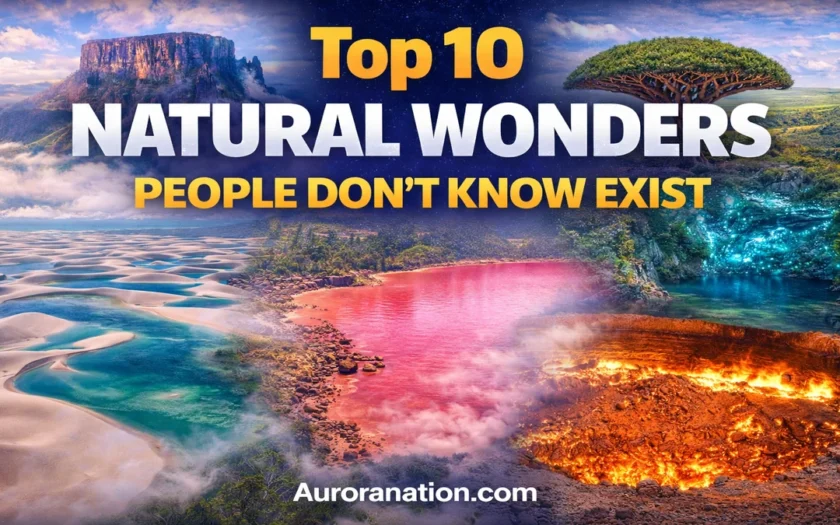
When people think about natural wonders, the same famous names tend to dominate the conversation. While those landmarks are impressive, they represent only a small fraction of what nature has created. Across the world, extraordinary landscapes remain largely unknown, not because they lack beauty, but because they are remote, protected, or rarely promoted.
This article explores the top 10 natural wonders people don’t know exist, revealing hidden places shaped by geology, climate, and time—often far from crowds and mass tourism.
Table of Contents
Why So Many Natural Wonders Remain Unknown
Many of the top 10 natural wonders people don’t know exist share common traits:
- Remote or difficult access
- Strict environmental protection
- Limited tourism infrastructure
- Low global media exposure
According to environmental research summarized by UNESCO, many fragile natural sites intentionally limit visitors to preserve ecosystems. As a result, some of the world’s most remarkable places remain quietly protected rather than widely advertised.
1. Socotra Island, Yemen
Socotra Island looks almost alien. Over one-third of its plant species exist nowhere else on Earth, including the iconic dragon blood tree.
Recognized by UNESCO for its ecological importance, Socotra remains one of the least visited islands globally. Limited access and conservation priorities keep it firmly among the top 10 natural wonders people don’t know exist.
2. Lençóis Maranhenses, Brazil
At first glance, Lençóis Maranhenses resembles a vast desert of white sand dunes. During the rainy season, however, thousands of freshwater lagoons form between the dunes, creating a surreal landscape.
Travel details from Visit Brasil show that international awareness remains low despite its uniqueness. The seasonal transformation keeps this wonder off most travelers’ radar.
3. Mount Roraima, Venezuela
Mount Roraima rises dramatically from the surrounding rainforest, with sheer cliffs and a flat summit isolated for millions of years. Its ecosystem has evolved independently, creating rare plant and animal life.
Geological explanations from Encyclopaedia Britannica highlight its significance, yet tourism remains limited due to challenging access.
4. The Danakil Depression, Ethiopia
One of the hottest and lowest places on Earth, the Danakil Depression features colorful sulfur springs, salt flats, and active volcanoes.
Scientific research discussed by National Geographic explains why this region is considered one of the most extreme environments humans can visit. Its harsh conditions keep visitor numbers extremely low.
5. The Marble Caves, Chile
Located on Lake General Carrera, the Marble Caves are carved into solid marble by water over thousands of years. Light reflections create swirling blue patterns inside the caves.
Tourism guidance from Chile Travel shows that access remains limited, preserving the caves’ pristine condition and placing them among the top 10 natural wonders people don’t know exist.
6. Lake Hillier, Australia
Lake Hillier is famous for its bright pink color, which remains even when water is removed. Scientists attribute the color to microorganisms and high salinity.
Research referenced by Geoscience Australia explains the lake’s unusual chemistry, yet it remains largely unknown outside scientific and aviation circles.
Also read: Life Below ZERO: Coldest Places on Earth Where People Still Live
Also read: Top 10 Most Underrated Places in the World Tourists Don’t Know About
Top 10 Quietest Places in the World to Escape Crowds
7. The Door to Hell, Turkmenistan
The Darvaza Gas Crater, often called the “Door to Hell,” has been burning continuously for decades in the Karakum Desert.
According to geological background from National Geographic, the crater formed after a drilling collapse. Its remote location keeps it one of the least visited fiery landscapes on Earth.
8. Waitomo Glowworm Caves, New Zealand
Hidden underground, the Waitomo Glowworm Caves are illuminated by thousands of bioluminescent insects, creating a star-like effect on cave ceilings.
Tourism information from New Zealand Tourism shows that many travelers overlook these caves while focusing on outdoor adventures, keeping them relatively uncrowded.
9. The Blue Eye, Albania
The Blue Eye is a natural spring with strikingly clear, deep-blue water that appears almost unreal. Its depth remains largely unexplored.
Despite growing interest, Visit Albania notes that the site receives far fewer visitors than comparable European natural attractions, helping preserve its calm atmosphere.
10. Chocolate Hills, Philippines
The Chocolate Hills consist of more than a thousand cone-shaped hills that turn brown during the dry season, giving them their name.
According to the Philippines Department of Tourism, international awareness remains limited, despite the formation being one of Southeast Asia’s most unique geological features.
How These Wonders Stay Hidden
The top 10 natural wonders people don’t know exist remain protected largely because:
- They lack large-scale development
- Travel logistics are complex
- Environmental regulations restrict access
Ironically, these limitations help preserve what makes them special.
Frequently Asked Questions (FAQs)
Why don’t people know about these natural wonders?
Many are located in remote regions or protected areas where tourism is intentionally limited.
Are these natural wonders safe to visit?
Most are safe with proper planning, guides, and respect for local regulations.
Which natural wonder is easiest to visit?
The Glowworm Caves and the Blue Eye are more accessible than places like Socotra or the Danakil Depression.
Will these places become crowded in the future?
Some may gain attention, but conservation policies often limit visitor numbers.
Final Thoughts
The top 10 natural wonders people don’t know exist remind us that discovery is still possible in a world dominated by social media and mass tourism. Beyond famous landmarks lie landscapes shaped quietly by nature, preserved through isolation and protection.
For travellers seeking something rare and meaningful, these hidden wonders offer not just beauty, but perspective—proof that the planet still holds secrets waiting to be found.