Quick Facts on Canada Small Business Carbon Rebate 2025
| Detail | Information |
|---|---|
| Program Name | Small Business Carbon Rebate (SBCR) |
| Administered By | Canada Revenue Agency (CRA) |
| Payment Period | October to December 2025 |
| Average Rebate Range | $2,000 – $6,000 |
| Eligible Provinces | Ontario, Alberta, Manitoba, Saskatchewan |
| Taxable Status | Non-Taxable |
| Eligibility | Canadian-Controlled Private Corporations (CCPCs) with 1–499 employees |
Thousands of Small Businesses Set to Receive Support
Thousands of small businesses across Canada are set to receive financial relief through the 2025 Small Business Carbon Rebate (SBCR) — a federal measure that returns a share of fuel charge proceeds to eligible employers.
The rebate, administered by the Canada Revenue Agency (CRA), is designed to ensure that smaller companies receive their fair portion of revenues collected through the federal carbon pricing system. While large corporations often have more capacity to absorb these costs, small businesses face tighter operating margins. The SBCR helps level the playing field by refunding part of the carbon charge through an automatic credit.
What Is the Small Business Carbon Rebate?
The Small Business Carbon Rebate is a refundable tax credit that does not require an application. If your business qualifies as a Canadian-Controlled Private Corporation (CCPC), CRA automatically calculates and issues the rebate based on your corporate tax filings.
The goal is simple: to return a portion of federal fuel charge revenues to small and medium-sized businesses operating in provinces where the federal carbon price applies.
Where the Rebate Applies
As of 2025, the SBCR applies to businesses operating in provinces under the federal fuel charge system. These include:
- Ontario
- Alberta
- Manitoba
- Saskatchewan
Businesses in provinces such as British Columbia, Quebec, and the Northwest Territories are excluded, as those jurisdictions manage their own carbon pricing programs.
If your company employs workers in multiple provinces, the rebate is determined based on the number of employees located in eligible regions.
Who Qualifies
To receive the 2025 Small Business Carbon Rebate, a company must meet the following criteria:
- Be a Canadian-Controlled Private Corporation (CCPC).
- Employ between one and 499 people.
- File its 2024 corporate income tax return by July 15, 2025.
- Have at least one employee in an eligible province.
- Be active and not exempt from income tax.
Once these requirements are met, the CRA will automatically process the rebate when assessing the company’s tax return. No additional forms or applications are necessary.
Estimated Payment Amounts by Province
Although the CRA has not published the official 2025 figures, previous data and regional revenue shares suggest that average rebate amounts will vary by province:
| Province | Estimated Average Rebate (2025) |
|---|---|
| Ontario | $2,000 – $3,500 |
| Alberta | $3,000 – $5,500 |
| Manitoba | $2,500 – $4,000 |
| Saskatchewan | $3,500 – $6,000 |
The exact amount depends on the size of the business, payroll levels, and the total number of employees working in federally regulated fuel charge provinces.
Payment Schedule for 2025
The CRA expects to issue rebate payments between October and December 2025.
Here’s how the process typically works:
- Businesses file their 2024 T2 corporate income tax return by the July 15, 2025 deadline.
- CRA verifies eligibility and calculates the rebate amount.
- Funds are deposited directly into the business’s bank account or sent by cheque.
Businesses registered for CRA direct deposit will see the payment listed as “CANADA CARBON REBATE – SMALL BUSINESS” on their account statement.
Those who file late or have incomplete information may receive their payment after December, once their return is reassessed.
Non-Taxable and Automatically Processed
In 2025, the federal government confirmed that the Small Business Carbon Rebate will be non-taxable. This means businesses do not have to include it in income or pay taxes on the amount received.
This ensures that every dollar of the rebate directly supports operating costs, payroll, or reinvestment in business growth.
The rebate is also automatic, meaning no application or follow-up forms are required. CRA handles the entire process once a company’s tax filing is complete.
How This Rebate Differs from the Household Carbon Rebate
The Small Business Carbon Rebate (SBCR) and the Canada Carbon Rebate (CAIP) serve different purposes but stem from the same federal carbon pricing system.
- SBCR is issued annually to businesses through CRA’s corporate tax system.
- CAIP is a quarterly payment sent directly to individuals and households to offset personal energy costs.
Both programs redistribute carbon charge proceeds, but the business rebate is tied to employee counts and corporate activity rather than household size or location.
Why the Rebate Matters in 2025
For many small businesses, energy costs remain a major operational challenge. Fuel charges can significantly impact sectors such as agriculture, transportation, food processing, and local retail.
The rebate provides a modest but meaningful return of funds to help these businesses manage costs, maintain jobs, and invest in cleaner operations.
By redistributing carbon pricing revenues, Ottawa aims to support economic growth while encouraging a gradual shift toward more sustainable energy use.
Outlook for 2026
The federal government has indicated that the Small Business Carbon Rebate will continue beyond 2025, with potential adjustments based on inflation and fuel charge revenue levels.
Expected updates include:
- Adjusted rebate amounts to reflect higher fuel charge collections.
- Continued non-taxable treatment for recipients.
- Possible expansion to additional provinces if federal pricing coverage changes.
Early forecasts suggest payments could rise by three to five percent in 2026, keeping pace with cost-of-living increases and carbon pricing adjustments.
How to Make Sure You Receive Your Payment
To ensure you receive your rebate on time, follow these steps:
- File your 2024 T2 return before the July 15, 2025 deadline.
- Keep your CRA My Business Account up to date.
- Verify that your direct deposit details are correct.
- Maintain accurate records of employee counts by province.
These steps help CRA confirm eligibility quickly and issue your payment without delay.
Frequently Asked Questions
Do I need to apply for the rebate?
No. CRA will automatically assess eligibility and issue payments to qualifying corporations.
Is the rebate taxable?
No. It is fully non-taxable and does not need to be reported as income.
When will I receive my payment?
Most payments will be made between October and December 2025.
Can sole proprietors or partnerships receive this rebate?
No. Only incorporated businesses that meet CCPC requirements are eligible.
How much will my business receive?
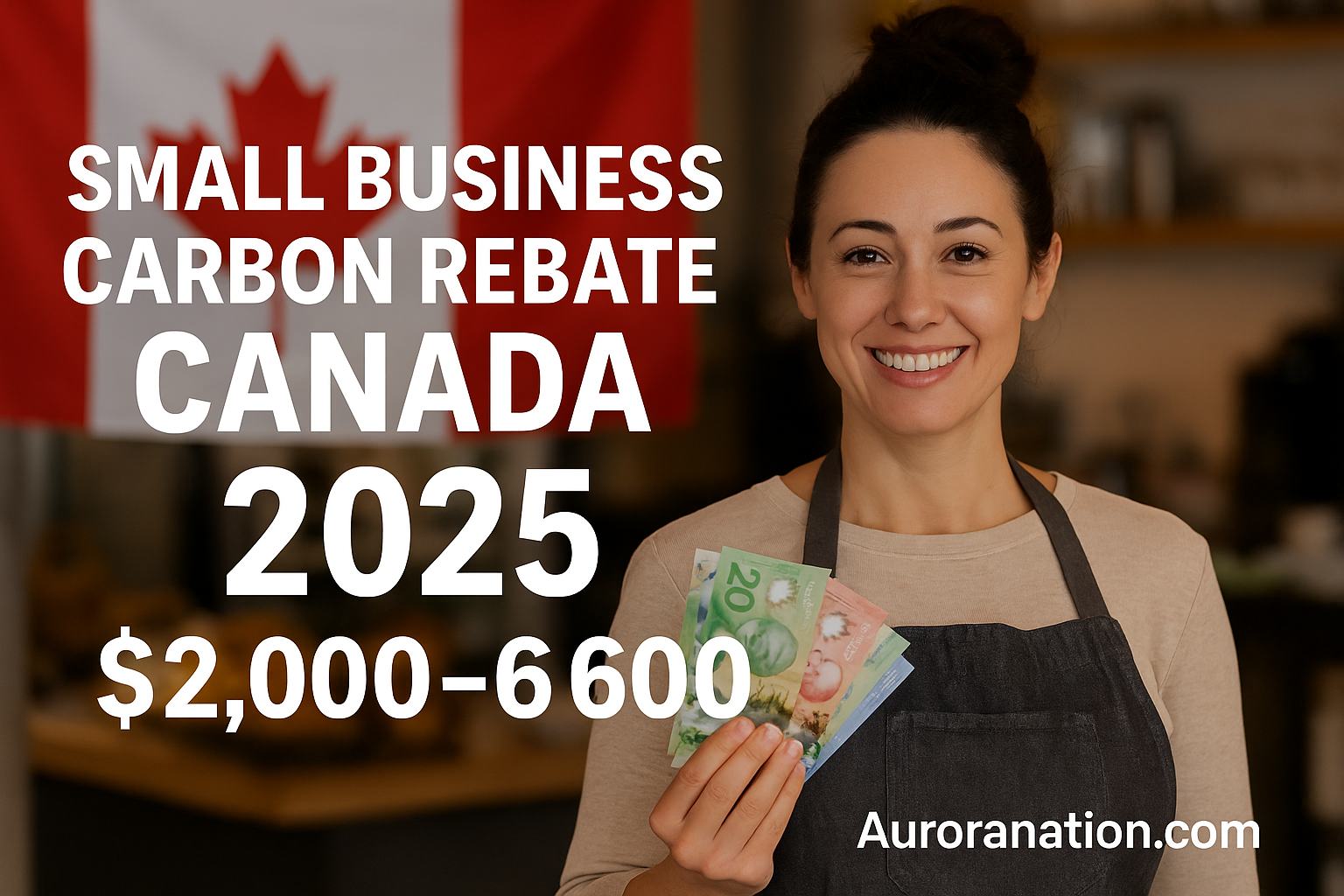
Rebate amounts vary by province and company size, ranging roughly from $2,000 to $6,000.
Final Word
The Canada Small Business Carbon Rebate 2025 represents a tangible benefit for small business owners facing rising operating costs. By automatically returning a portion of carbon charge revenues, the CRA ensures that smaller employers — especially those in Ontario, Alberta, Manitoba, and Saskatchewan — receive direct financial relief.
With payments arriving in late 2025 and a continued focus on cost-of-living adjustments for 2026, this rebate stands as one of the most significant ongoing supports for small and medium-sized businesses in Canada.