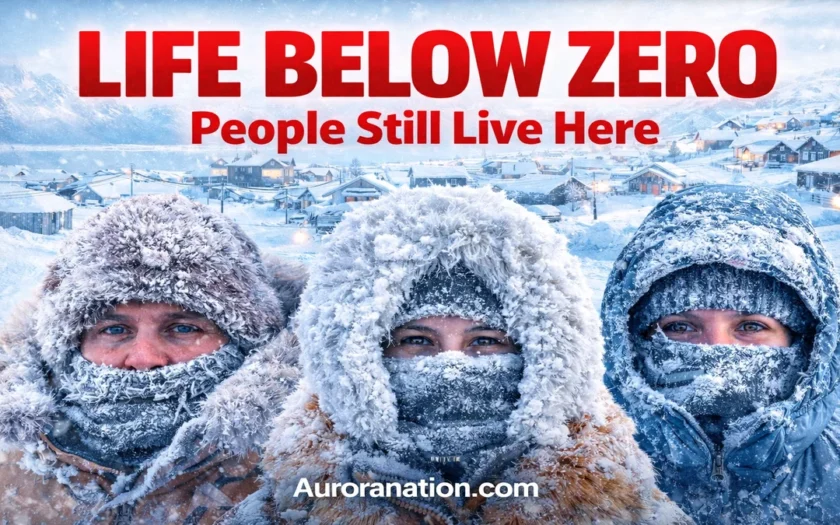
When most people imagine extreme cold, they think of places no human could survive. Yet across the planet, entire communities live year-round in temperatures that routinely fall far below freezing. These settlements are not temporary research stations or seasonal camps—they are permanent homes with schools, hospitals, and daily routines shaped by ice, snow, and darkness.
This article explores the coldest places on Earth where people still live, examining how communities adapt, why people remain, and what life is really like in environments that push human endurance to its limits.
Also read:Top 10 Most Underrated Places in the World Tourists Don’t Know About
Also read: Top 10 Unique Travel Destinations in the World You Won’t Find in Typical Guides
Table of Contents
What Defines the Coldest Places on Earth Where People Still Live
The coldest inhabited places on Earth share several defining characteristics:
- Long winters with temperatures below −30°C
- Short daylight hours or extended polar nights
- Frozen ground (permafrost) that affects construction
- Limited access to supplies and transportation
According to climate data referenced by the World Meteorological Organization, these regions experience some of the most extreme seasonal temperature variations on the planet, yet remain permanently populated.
1. Oymyakon, Russia
Oymyakon is often cited as the coldest permanently inhabited place on Earth. Winter temperatures regularly fall below −50°C, with historic readings approaching −67°C.
Despite the cold, families live here year-round. Children attend school unless temperatures drop below extreme thresholds, and residents rely on fur clothing, constant heating, and specially adapted vehicles. Studies cited by the World Meteorological Organization confirm Oymyakon’s status as one of the coldest places on Earth where people still live.
Life here is defined by preparation—fuel, food, and equipment must always be ready.
2. Yakutsk, Russia
Yakutsk is the coldest major city in the world, home to more than 300,000 people. Winter temperatures commonly remain below −40°C for weeks at a time.
The city is built entirely on permafrost, meaning buildings are raised on stilts to prevent heat from melting the ground beneath them. Research from the Russian Academy of Sciences documents how engineering innovations make modern urban life possible in such extreme cold.
Yakutsk proves that even large cities can exist among the coldest places on Earth where people still live.
3. Verkhoyansk, Russia
Verkhoyansk rivals Oymyakon for extreme cold and experiences some of the widest temperature ranges on Earth—from below −50°C in winter to over 30°C in summer.
Climate research shared by the World Climate Research Programme explains how continental climate patterns trap cold air in the region during winter months.
Despite its isolation, Verkhoyansk has remained inhabited for centuries, relying on seasonal planning and local resilience.
4. Norilsk, Russia
Norilsk is one of the northernmost cities on Earth and one of the harshest places to live. Temperatures stay below freezing for most of the year, and winter darkness can last weeks.
The city exists largely due to mining, and daily life is adapted to extreme cold through enclosed walkways and indoor infrastructure. According to Encyclopaedia Britannica, Norilsk’s population continues to grow despite its challenging environment.
It remains one of the coldest places on Earth where people still live permanently.
5. Utqiaġvik (Barrow), Alaska, USA
Utqiaġvik is the northernmost city in the United States. It experiences polar night, with no sunrise for over two months in winter, and temperatures often drop below −30°C.
Indigenous knowledge combined with modern technology plays a critical role in survival. Research from the National Snow and Ice Data Center highlights how Arctic communities manage extreme cold through adaptive housing, subsistence hunting, and careful resource planning.
6. Yellowknife, Canada
Yellowknife is known for its brutally cold winters, with temperatures frequently reaching −40°C. Despite this, it remains a thriving regional hub in northern Canada.
Information from the Government of Northwest Territories shows how infrastructure, emergency services, and community planning are designed specifically for extreme winter conditions.
The city’s resilience places it firmly among the coldest places on Earth where people still live.
7. Iqaluit, Canada
As the capital of Nunavut, Iqaluit faces extreme cold, strong winds, and long winter darkness. Temperatures often remain below −30°C during winter months.
According to the Government of Nunavut, Inuit traditions and modern governance together support permanent settlement in the Arctic.
High costs and logistical challenges persist, but population growth continues.
8. Nuuk, Greenland
Nuuk is one of the coldest capital cities in the world. While coastal waters slightly moderate temperatures, winters remain long and severe.
Climate data from the Danish Meteorological Institute explains how sea ice and Arctic weather systems influence daily life in Greenland’s capital.
Despite harsh conditions, Nuuk supports education, culture, and government year-round.
9. Harbin, China
Harbin experiences some of the coldest winters among major cities in East Asia, with temperatures regularly falling below −25°C.
The city has adapted culturally and architecturally, embracing its climate through winter festivals and specialized infrastructure. Data from the China Meteorological Administration shows Harbin’s winters are among the coldest for large urban populations.
10. Ulaanbaatar, Mongolia
Ulaanbaatar is the coldest national capital in the world on average. Winter temperatures frequently drop below −30°C, and heating challenges contribute to severe air pollution.
Environmental studies referenced by the United Nations Environment Programme show how extreme cold and coal-based heating intersect to create public health challenges.
Despite this, Ulaanbaatar continues to grow as Mongolia’s economic and cultural center.
How People Survive in Extreme Cold
Across the coldest places on Earth where people still live, common survival strategies include:
- Highly insulated housing
- Layered clothing systems
- Seasonal food storage
- Limited outdoor exposure during peak cold
- Strong community cooperation
Cold does not define livability—adaptation does.
Why People Choose to Stay
People remain in these regions for many reasons:
- Cultural and ancestral ties
- Employment opportunities
- Community identity
- Economic necessity
For residents, cold is not a crisis—it is a known and managed condition.
Final Thoughts
The coldest places on Earth where people still live demonstrate the remarkable adaptability of human life. Through innovation, culture, and resilience, communities have learned to thrive in environments that test the limits of survival.
These regions remind us that livability is shaped not by climate alone, but by how humans respond to it.